The Two-Thirds Rule Is Rewriting California’s Tax Ballots
In 2000, 18% of California’s local general-tax ballot questions named a service like police or potholes. In 2024, 89% did.
Every new local tax in California needs voter approval. A special tax is one earmarked for a specific purpose and, since Prop 13, needs two-thirds of the vote to pass. A general tax can be spent on anything and needs only a simple majority.
Voters prefer earmarks, but Prop 13 puts earmarks behind a two-thirds vote. So over the past two decades, general-tax ballot questions have started listing services too. Now the two kinds of tax read almost the same on the ballot, but one needs two-thirds and the other a majority.
General taxes now list services
We looked at every city and county tax measure in the California Elections Data Archive, 1996–2024 (3,250 measures), and counted the distinct public services each ballot question names: police, fire, streets, parks, libraries, homelessness, and so on.
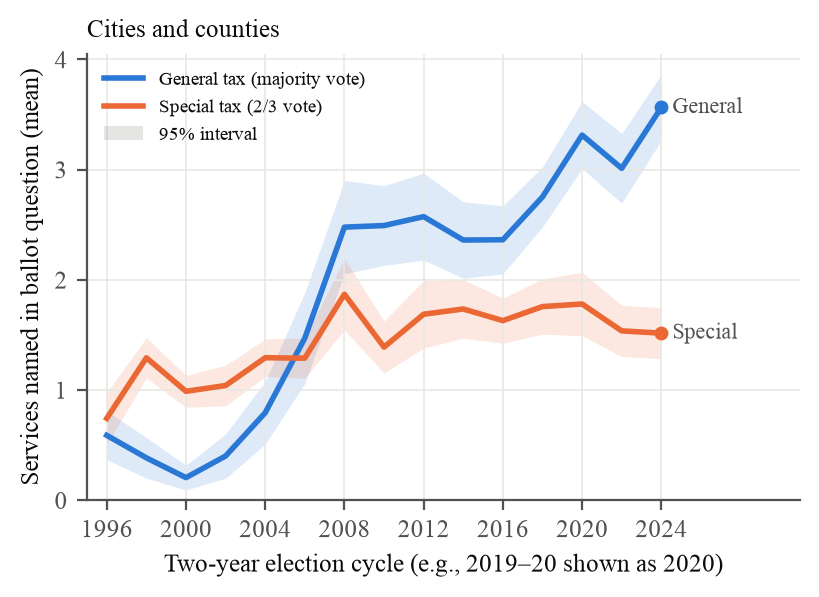
In 2000, 18% of general-tax questions named any service. In 2024, 89% did, averaging 3.5 services per question. Special taxes, whose money must by law go to their stated purpose, averaged only 1.5.
For example, here’s the same kind of tax in the same city, eighteen years apart. Watsonville’s general sales tax in 2004 (Measure Q, 37% yes, failed):
Shall the City of Watsonville adopt a sales tax increase of one-quarter percent?
And in 2022, Measure R asked for twice as much, a half cent with no end date (64% yes, passed):
To provide locally-controlled funding for Watsonville’s essential general services, including: afterschool and anti-gang programs that keep kids safe; creating safe places to play; keeping parks/Watsonville Slough trails safe and clean; repairing, expanding, improving parks/playgrounds; fixing potholes; maintaining streets; creating jobs; supporting local businesses, libraries, senior meal programs and general government use; shall the City of Watsonville measure be adopted levying one-half cent sales tax, until ended by voters, providing $5 million dollars annually, with community oversight?
And lists pass
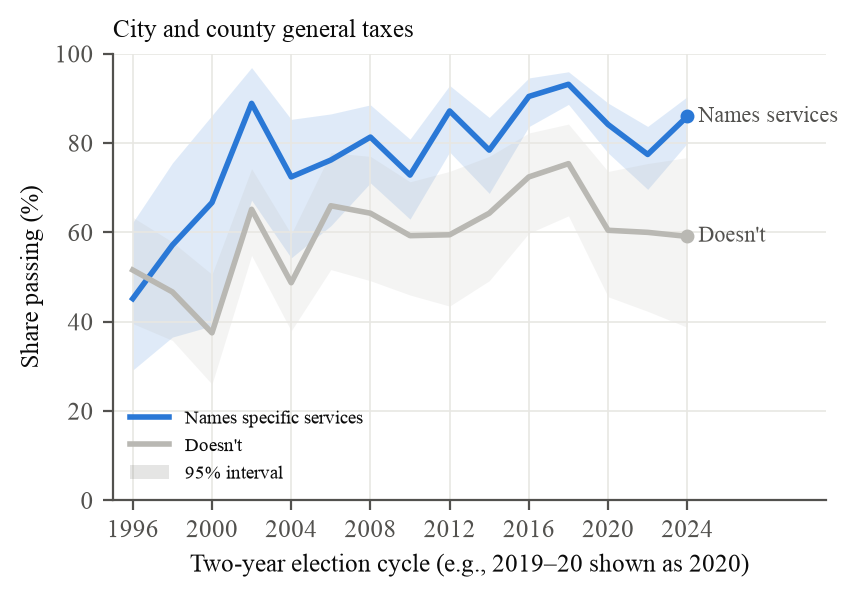
General taxes that name services pass 82% of the time; those that don’t pass 59%. The service-listing line is on top in 14 of 15 cycles (the exception, 1996, is within the noise).
Comparing measures within the same city, controlling for tax type and the county’s political climate that year, naming services goes with an 18-point higher chance of passing (±9) and about 7 more points of “yes” vote. Among cities that lost and tried again, the 22 that switched from a bare question to a list gained 21 points and 19 of them passed; the other 90 retries gained 10 points and 62% passed.
Example: Turlock sales tax
Turlock, a Central Valley city of 73,000, has asked its voters for a sales tax three times.
- 2004, general tax, bare question (“Shall the City of Turlock impose a one-half of one cent ($.005) transaction and use tax?”): 49.6% yes, failed. (Measure F)
- 2014, special tax, half a cent for seven years, “to be used exclusively for” street repair: 60.8% yes, the most popular of the three, but short of two-thirds. Failed. (Measure B)
- 2020, general tax, three-quarters of a cent with no end date, “to maintain fire, 9-1-1 emergency medical response, neighborhood safety…; address homelessness…; repair streets, potholes…; and other general services”: 56.7% yes, passed. (Measure A)
Voters liked the real earmark best, but it needed two-thirds. The version that passed listed potholes among much else, needed only a majority, and carries no legal restriction on how the money is spent. It was also the biggest ask of the three.
Is the list binding?
A general tax goes into the general fund and is budgeted like any other revenue. Even an advisory measure passed alongside the tax, saying how to spend it, doesn’t bind the government (Johnson v. County of Mendocino, 2018). Among the 773 service-listing general taxes of 2016–2024, 68% introduce the list with “such as” or “including,” and about a third never use the word “general.”
None of this requires bad faith. Police and fire are usually the biggest items in a city’s general fund, so the list is often a fair picture of where general revenue goes.
Why: two rules from the Prop 13 family
Voters must approve every local tax. Prop 13 (1978) required a two-thirds vote for special taxes; Props 62 (1986) and 218 (1996) required a vote on general taxes too. Before 1978 our elected officials could simply do their jobs and set taxes. There was no ballot question to write.
Earmarked money costs two-thirds; unrestricted money costs a majority. Today, what voters find most appealing sits behind the higher threshold, and what makes for workable budgets (revenue the council can allocate as needs change) sits behind the lower one. So now almost all taxes we vote on are general taxes:
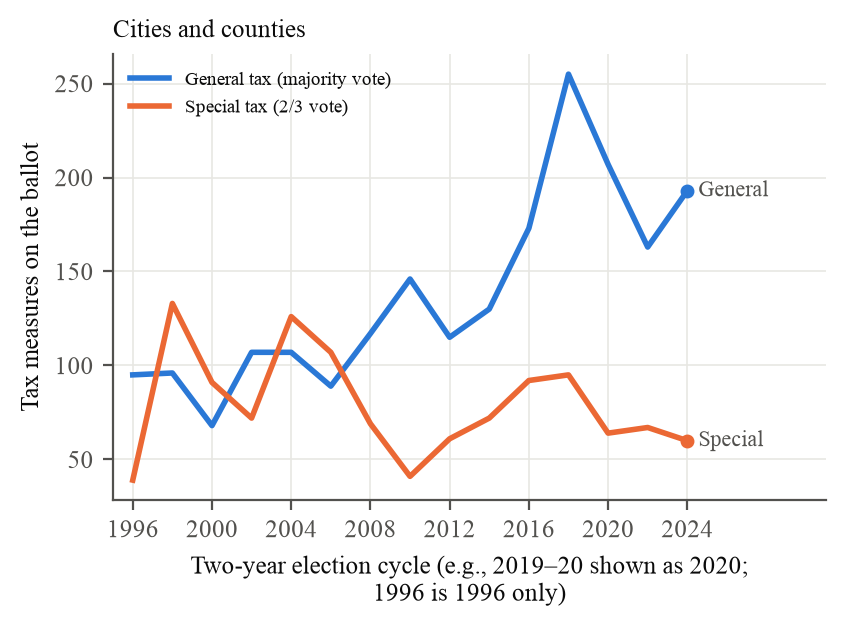
Special taxes fell from about half of city and county tax measures in 1998–2006 to about a quarter since 2018, while general taxes roughly doubled (the 2018 spike is cannabis). 54% of general taxes that pass get less than two-thirds of the vote, so they would have failed as special taxes.
It gets stranger. Since a 2017 state Supreme Court decision (Upland), courts have held that the two-thirds rule applies only to taxes a local government puts on the ballot. The identical earmarked tax, placed there by a citizen petition, needs a simple majority. So the threshold depends on who collected the signatures. Prop 43, on this November’s ballot, would require two-thirds for petition taxes too.
The pass-rate gap between general and special taxes is well documented by Michael Coleman at CaliforniaCityFinance.com and by the Legislative Analyst’s Office. Martin, López, and Olsen (2019) found that naming emergency services on a city tax ballot was worth about 5 points of “yes” vote in 1996–2010; our 7 points agree. A 2022 Santa Cruz County grand jury described the recipe for one county’s sales tax.
Data and code are available on request at info@prop13.wtf. Cannabis taxes are included. Service counts come from a keyword match on the ballot question across twelve categories; on 300 questions hand-coded blind, it agreed on whether a question names any service 97% of the time. The same-city comparison uses 1,698 general taxes in 370 cities that voted on at least two.
Corrections and data questions: info@prop13.wtf.